

A strategy for enabling radiopharmaceutical development for molecules with strong target binding but which struggle to meet pharmacokinetic requirements for radionuclide conjugation, such as antibody-based vectors.
An in vitro candidate that can successfully target and bind an oncology target is often an excellent starting point for radiopharmaceutical development. However, a strong binder does not necessarily guarantee a strong radiopharmaceutical.
“The preclinical development of a radiopharmaceutical is profoundly different from the development of a non-radionuclide-based drug,” explains Pierre Adumeau, Head of Study and Research Unit in Imaging and Molecular Radiotherapy at Oncodesign Services. “Once radiolabeled, a candidate must do considerably more than bind its target. It needs to reach the tumor or targeted tissue, remain there for an appropriate period and clear sufficiently from non-targeted tissues. Its pharmacokinetics must also be compatible with the physical half-life of the selected radionuclide.”
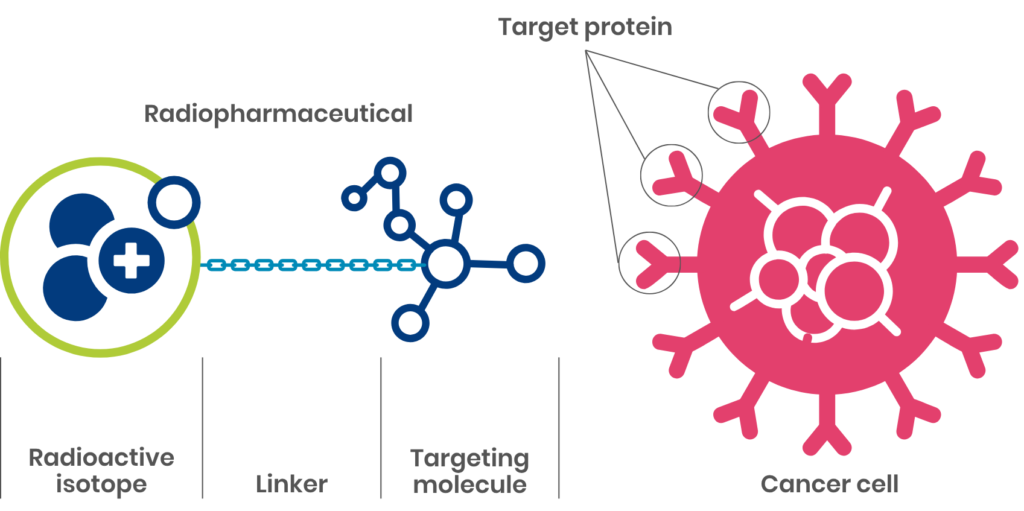
A radiopharmaceutical is made up of two critical elements: the targeting molecule and the radioactive isotope, often requiring a linker to attach them. By tethering a radioactive payload to a targeting molecule, this form of radiotherapy can be highly specific, combining strong tumor-killing capabilities with vectorization to reduce collateral damage to healthy tissue.
The pharmacokinetics demanded by an effective radioligand therapy can present a problem for some molecules, particularly for larger targeting vectors such as antibodies. Their prolonged circulation and relatively slow tumor accumulation may require the use of longer-lived radionuclides. The result can be extended irradiation of the blood cells and healthy tissues while researchers wait for the targeting vector to accumulate in the tumor and clear from the background.
Incorporating pretargeting into early preclinical strategy offers a different way to approach and forward-manage this problem.
Two components and two sets of pharmacokinetics.
In a directly labeled radiopharmaceutical, the targeting vector and radionuclide travel through the body as a single compound. Pretargeting separates tumor targeting from radionuclide delivery.
“First, a modified targeting vector is administered and allowed to bind to its target. Once sufficient tumor accumulation and clearance from the circulation have occurred, a small radiolabeled effector is administered,” Pierre explains. “This second component binds rapidly to the pre-localized targeting vector in vivo, while any unbound effector clears quickly.”
Several molecular systems can support this interaction, including click chemistry, oligonucleotide hybridization, bispecific antibody-based approaches, and host–guest interactions. Although the mechanisms differ, the underlying principle is the same: the targeting vector finds the tumor first, and the radioactivity follows later.
How does this change some of the constraints placed on the original candidate?
“Most importantly, the pharmacokinetics of the targeting vector no longer need to match the half-life of the radionuclide. A slowly distributing antibody, for example, can potentially be combined with a rapidly clearing effector carrying a shorter-lived radionuclide,” says Pierre.
Pretargeting does not prevent the targeting vector from accumulating in healthy tissues. Instead, it can prevent any off-target vector uptake from automatically becoming off-target radionuclide exposure. If the radiolabeled effector cannot access or bind to the vector retained in those tissues, it can clear without depositing a substantial radioactive dose there.
While pretargeting is not a universal solution, it can offer several advantages:
- Lower radiation exposure in healthy tissues. The radioactive effector generally circulates for much less time than a directly labeled antibody or other large vector. Rapid clearance of unbound radioactivity can reduce irradiation of the blood and limit accumulation in non-target tissues.
- Higher tumor-to-background ratios. Separating the targeting and radionuclide-delivery phases can produce cleaner biodistribution profiles. For diagnostic agents, this may improve imaging contrast and allow imaging sooner after administration of the radionuclide. For therapeutic agents, increased tumor-to-background ratios may support a wider therapeutic index.
- Greater development flexibility. The targeting vector and radiolabeled effector can be optimized independently. This creates additional room to adjust vector format, effector structure, chelator, radionuclide, and dosing schedule without redesigning the entire construct every time one element changes.
- A more modular development platform. Once a targeting vector and pretargeting chemistry have been established, the same system may be paired with different radiolabeled effectors. One radionuclide could support diagnostic imaging and another could support therapy, creating the potential for a platform-like and/or theranostic approach.
Collectively, these characteristics can make pretargeting particularly interesting when an in vitro candidate has attractive binding properties but pharmacokinetics that are poorly suited to direct radiolabeling. For this reason, it is essential to properly understand the pharmacokinetic profile of an in vitro candidate prior to radiopharmaceutical development.
Is pretargeting a radiopharmaceutical development shortcut?
“Not exactly,” Pierre cautions. “Pretargeting removes or relaxes some of the challenges associated with direct labeling. However, it also introduces a new layer of biological, chemical and logistical complexity.
“The targeting vector must remain accessible within the tumor when the effector arrives. Internalization, metabolism or target shedding could reduce that accessibility. Meanwhile, the effector must reach the relevant tissue, bind sufficiently rapidly, and clear without unwanted retention elsewhere.”
Timing is also critical. If an effector is administered too early, excess targeting vector may remain in circulation, increasing background exposure. If administration is too late, the tumor-associated vector may have internalized, degraded or otherwise become inaccessible. Finding the optimal interval that balances tumor accumulation, vector accessibility and systemic clearance is therefore a critical component of optimization.
“The effector itself may require substantial development. Small structural changes can influence renal or hepatic retention, clearance and access to the tumor, and finding the appropriate balance between these parameters may prove difficult. It must also carry a radionuclide whose half-life remains compatible with its own pharmacokinetics. The radionuclide–pharmacokinetic relationship is still a key factor; it has just moved from the targeting vector to the effector.”
These variables mean that pretargeting should not be viewed as a universal route from a good binder to a successful radiopharmaceutical. Pretargeting should instead be considered an alternative development strategy that exchanges some of the constraints of direct labeling for a different, potentially more manageable optimization problem.
Are there any downsides to using pretargeting?
In drug discovery and development, alternative solutions rarely come without trade-offs. Pretargeting is no exception. While pretargeting can create a radiopharmaceutical opportunity for powerful but otherwise less suitable targeting vectors, there are regulatory and clinical factors to consider.
“Pretargeting is going to be more challenging from a regulatory point of view,” Pierre explains. “You will need to validate the whole system rather than one single drug, including the vector and the radiolabeled effector, plus validation that the administration intervals are optimized, etc. It will be a heavier dossier.
“The second aspect is that the patient will need to be dosed twice within a set timeframe. That means more appointments at the hospital, with associated travel, and less flexibility to move those appointments around. While additional logistics can be managed and mitigated with effective planning, they will still be taken into account when considering clinical translation.”
More than strong binding is required for a viable in vitro radiopharma candidate.
The transition from an in vitro candidate to a radiopharmaceutical requires consideration and understanding of the complete in vivo system. Targeting vector format, radionuclide, chelator, biodistribution, clearance, tumor retention and treatment schedule can all influence whether promising binding data translate into imaging or therapeutic efficacy.
Pretargeting offers greater flexibility to radiopharmaceutical design, creating opportunities for molecules that might otherwise be incompatible. “For some candidates, this strategy can separate desirable tumor targeting from undesirable radionuclide exposure and enable combinations that would be difficult to achieve through direct labelling,” Pierre concludes.
To learn more about pretargeting and other approaches to preparing promising binders for radiopharmaceutical development, join our webinar, Optimizing In Vitro Candidates for Radiopharmaceutical Development, on Thursday, September 24th at 16:00 CEST / 15:00 BST / 10:00 EDT.

Scientific Contributor
Pierre Adumeau, PhD.

With over a decade of experience, Pierre Adumeau specializes in radiochemistry, molecular imaging, and the development of targeted radiopharmaceuticals for oncology.
Pierre earned his Ph.D. in Chemistry from Université Blaise Pascal (Clermont-Ferrand, France), where his research focused on organic chemistry, nanomaterials, and fluorescence imaging. He subsequently conducted postdoctoral research at the laboratory of Professor Brian Zeglis at Hunter College, City University of New York, and at the Institute of Molecular Chemistry, University of Burgundy, where he contributed to the design and development of novel radiotracers and targeted radiopharmaceuticals for cancer diagnosis and therapy. His work has resulted in numerous peer-reviewed publications and contributions to advances in nuclear medicine and molecular imaging.
Today, Pierre serves as Head of Study Unit at Oncodesign Services, where he leads multidisciplinary research programs supporting pharmaceutical and biotechnology partners in the development of innovative radiopharmaceuticals.