
Ressource Scientifique

Actualités
14/12/2022
Oncodesign Services looks to the future
As Oncodesign evolves into Oncodesign Services and begins its journey as an independent business, CEO Fabrice Viviani explains his hopes and plans for the company’s future

Publication scientifique
25/11/2022
Calcium(II)-Catalyzed Chemoselective and Regioselective Epoxide Ring-Opening with NH Sulfoximines
In this paper we describe methods for the Organic Synthesis of 1,2-sulfoximidoyl ethanols thanks to an Epoxide Ring Opening with NH Sulfoximines. Read more.

Blog
08/11/2022
Why studying the gut microbes could help to cure?
We explore the importance of Gut Microbes on our health by discussing five of those Gut-Organ Axis - brain, intestine, liver, lung, and skin. Read more here.
Publication scientifique
03/11/2022
Intranasal delivery of a chimpanzee adenovirus vector expressing a pre-fusion spike (BV-AdCoV-1) protects golden Syrian hamsters against SARS-CoV-2 infection
We investigated the efficiency of Vaccine Vector based on Chimpanzee Adenovirus in golden Syrian hamsters against SARS-Cov-2 infection. Learn more here.
Poster
01/11/2022
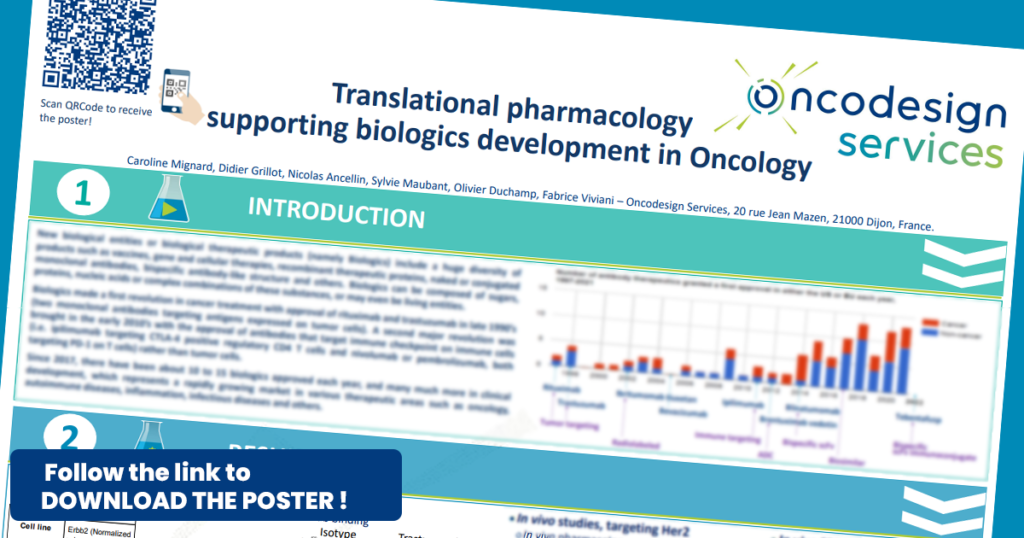
Translational pharmacology supporting biologics development in Oncology
Translational Pharmacology is responsible for connecting products of novel molecular research, such as Biologics, to the patients that need it. Learn more here.
Webinaire
13/10/2022
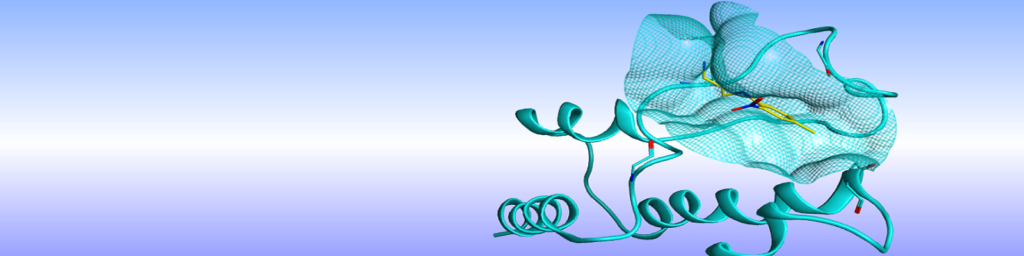
Fragment-Based Drug Discovery — Hitting Targets Using the Right Chemistry and Expertise Alliances
Learn about Fragment-Based Drug Discovery (FBDD) and its Applications in our Webinar with leading experts from the field of FBDD.
Poster
02/09/2022
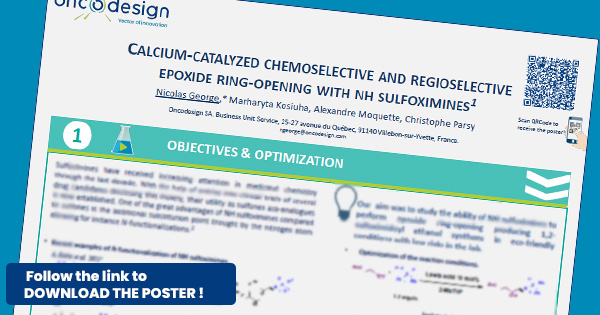
Lewis acid catalyzed chemoselective and regioselective epoxide ring opening with sulfoximines
We report Sulfoximines with the first regioselective Epoxide Ring opening; these findings broaden their Drug Discovery and design applications. Read more.
Publication scientifique
30/08/2022
Comparison of the Anti-Tumour Activity of the Somatostatin Receptor Antagonist 177Lu-Satoreotide Tetraxetan and the Agonist 177Lu-DOTA-TATE in Mice Bearing AR42J SST2-Positive Tumours
Read now our new scientific publication focused on Anti-Tumour Activity!

Poster
29/06/2022
In vitro pharmacological profile of Compound A
Strong genetic evidence has validated Leucine-Rich Repeat Kinase 2 (LRRK2) as a target of interest for Parkinson’s Disease.
Poster
29/06/2022
In vivo PK/PD profile of Compound A
Mutations in Leucine-Rich Repeat Kinase 2 (LRRK2) are the most common genetic cause of Parkinson’s disease, leading to the development of LRRK2 inhibitors as potential therapeutic approach. Among them, Compound A has recently been selected as a potent, selective and brain-penetrant LRRK2 inhibitor.
Poster
08/04/2022
Lead optimization of radiopharmaceuticals for molecular radiotherapy and preclinical evaluation
Get to know more about lead optimization of radiopharmaceuticals for molecular radiotherapy and preclinical evaluation!
Poster
08/04/2022
Mouse models of hepatocellular carcinoma
Get to know more about our comprehensive & functional preclinical platform for immunotherapy research using mouse models (PDX, human transgenic mouse).