


Why emission range and linear energy transfer matter in targeted radiotherapy design.
Over the last five years, radioemitters as a mechanism of action have grown sharply in popularity, with an exponential number of candidates entering preclinical development every year. Despite having its own unique challenges, targeted radiotherapy (TRT) is full of promise as a powerful cancer treatment – as we can see from the impact of Lutathera and Pluvicto.
A conversation we often have at oncology and nuclear medicine conferences is ‘alpha emitters versus beta emitters’. In targeted radiotherapy, the choice between alpha and beta emitters shapes everything from mechanism of action to tumor-level performance, and their radiobiology have notable differences.
Beta Emitters
Beta emitters deliver lower linear energy transfer (LET) over a longer path length. This extended range allows them to cross multiple cell diameters, making them historically attractive for larger, more heterogeneous tumors. Lutetium-177 remains the workhorse of this class, with Terbium-161 emerging as a promising successor thanks to early evidence of higher efficacy at comparable doses.
Alpha Emitters
Alpha emitters behave differently. Their range rarely extends beyond a single cell, but their LET is orders of magnitude higher, producing intense, highly localized deposited energy with higher DNA damage impact. This has traditionally positioned alphas as candidates for small lesions and micrometastatic disease. Yet accumulating preclinical and clinical evidence suggests their utility may stretch further: high-density energy deposition and secondary biological effects (including immune activation and reactive oxygen species generation) appear to support efficacy, even in larger tumors.
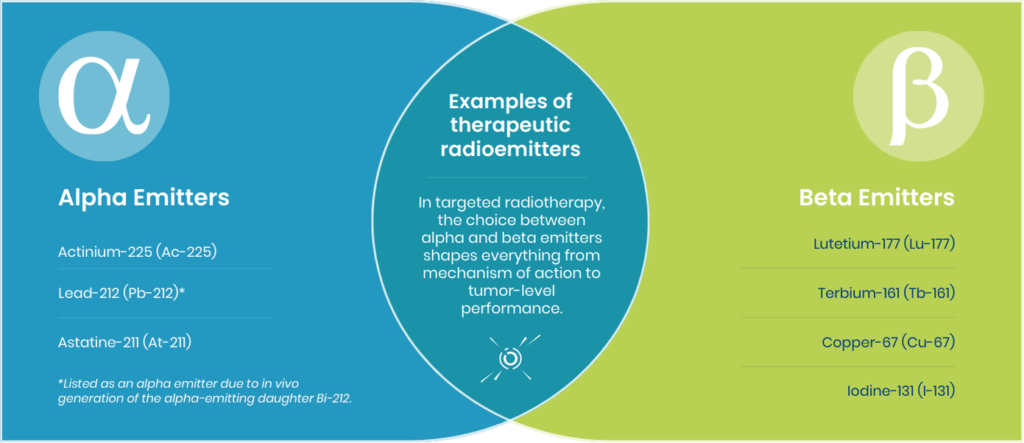
Developmentally, the alpha and beta emitters alike represent a challenging field of research. As an example, there are alpha radionuclides which decay through extended chains of daughter radionuclides, each with its own emission profile. This can introduce radiolysis and product-stability issues, as well as uncertainties around biodistribution of daughter radionuclides and consequently long-term radiotoxicity. Actinium-225 dominates current alpha programs despite these complexities, while nuclides such as Lead-212 and Astatine-211 are drawing attention, bringing new chemistry (and new obstacles such as supply availability) with them.
“Alpha versus beta” is an interesting question. However, a more nuanced question to ask when considering delving into this rapidly emerging field is “which emitter best matches the biological and logistical demands of a given therapeutic concept?”