
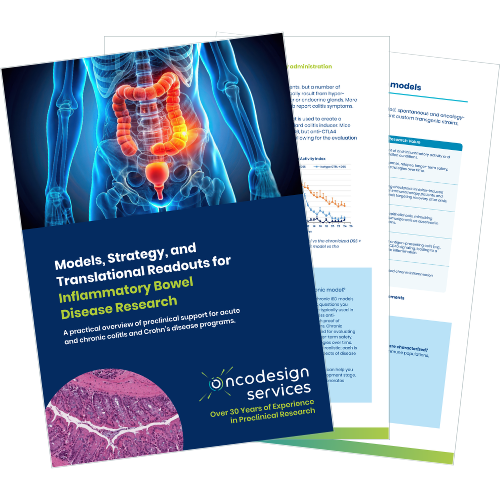

Pharmacology services to advance preclinical progress in inflammatory and autoimmune disease research.
Oncodesign Services provides flexible CRO support for the preclinical development of novel inflammation and autoimmunity therapeutics. We have specialized in preclinical research for more than three decades, and in inflammatory diseases for over 10 years.
We are AAALAC accredited and provide in vitro, in vivo, and ex vivo studies using a portfolio of validated cell lines and models. We can also facilitate de novo model development if one of our standard models is not an ideal fit.
Speak with our team to learn more about our translational pharmacology and preclinical imaging services.
Our priority is to deliver reliable, timely results that help advance your program, transparent communication, and proactive project management. In addition, we offer:
- Access to a board-certified veterinary pathologist
- Humanized models to investigate cross-reactivity or human-specific biology
- Functional readouts to strengthen translatability
- Longitudinal assessment in alignment with the 3Rs
- Tailored protocols and study design
- Standalone studies and stepwise programs with stop/go inflection points
- Early intervention and proactive engagement if study challenges arise
Inflammation research areas and solutions
Oncodesign Services supports the following areas of autoimmune and inflammatory disease research. Visit the webpage for your disease or disease area to learn more about specific model availability, histology samples for feasibility studies, and disease induction methods.
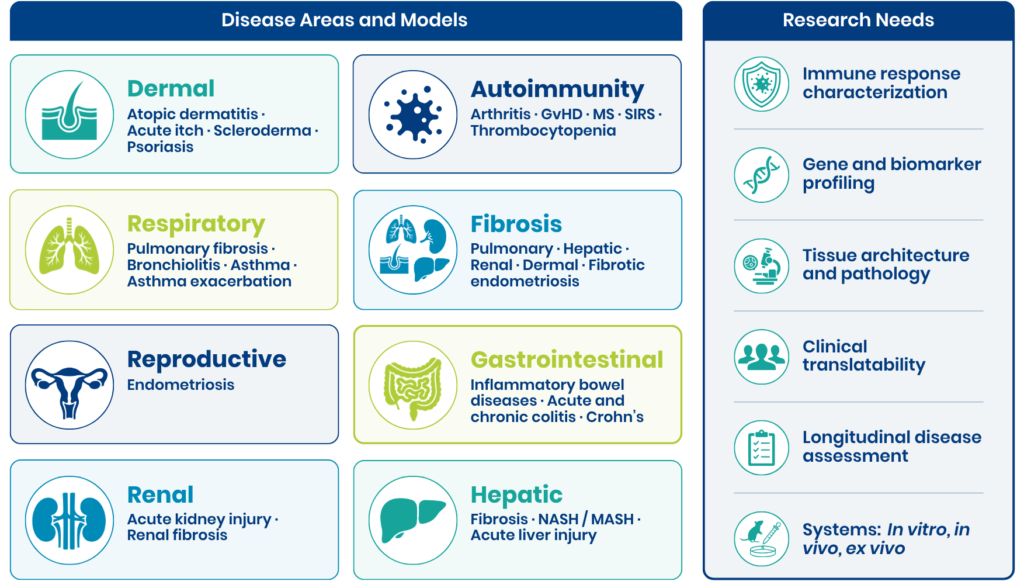
Human-specific target engagement and/or cross-reactivity
Humanized immune systems, human cell replacement and humanized target models can support compounds that do not interact appropriately with the corresponding murine target.
Immune response characterization
Available approaches include flow cytometry, immunohistochemistry, ELISA and multiplex cytokine analysis.
Molecular response and biomarker assessment
Gene and biomarker profiling can be performed using qRT-PCR, dPCR and complementary analytical approaches.
Tissue-level disease change evaluation
Histopathology, image analysis and review by a board-certified veterinary pathologist support assessment of tissue architecture and pathological response.
Strengthening clinical translatability
Functional readouts and clinically relevant biochemistry can help connect biological activity with outcomes that are meaningful in patients.
Longitudinal disease monitoring
Imaging approaches can support non-invasive monitoring, lesion detection and diagnostic validation.
Study design that fits your preclinical plan.
Some research teams approach us with a strongly defined plan and comprehensive study outline, and other teams prefer additional scientific guidance. Regardless of where you are on this spectrum, our scientific team is experienced in adapting their input to the level of design and support you require, and the stage and needs of your program.
We can help you:
- Design your study from the ground up, or review an existing study design for feasibility and technical fit
- Select research models, protocols, dosing strategy, and endpoints
- Adapt established protocols to your compound where appropriate
- Identify practical considerations before the study begins
- Execute the study with clear communication and scientific oversight
- Interpret the findings and discuss their implications for your program
Working with Oncodesign Services and next steps:
Oncodesign Services combines translational inflammation experience with a flexible approach to preclinical inflammation research, supporting both standard and customized study designs. Alongside an extensive portfolio of acute and chronic inflammatory disease models, we offer bespoke model development to address specific scientific objectives.
Our lab teams are experienced in technically demanding procedures, including specialized dosing routes, surgical techniques, functional assessments, and longitudinal monitoring. Where required, our scientists are available to provide guidance from study planning through data interpretation.
Contact us to discuss your research objectives, explore feasibility, and request a quotation.
Oncodesign Services (ODS) has been a trusted preclinical partner for several years. The team consistently demonstrates scientific excellence and reliability, tailoring preclinical protocols to our exact needs.
Their ability to rapidly action and deliver projects has made collaboration in oncology research efficient and straightforward. Clear, responsive communication is crucial to us, and the strong working relationship with our client manager makes coordination very easy.
We appreciate the professionalism, confidence, and flexibility ODS brings to every project.
Oncology Biopharma Organization (Europe)


Frequently asked questions about our inflammation CRO services:
How is pathology assessed?
Histology and immunohistochemistry can be supported by digital image analysis and assessment by a board-certified veterinary pathologist. Pathology findings can be interpreted alongside biomarkers, immune profiles, clinical observations and functional endpoints to provide a comprehensive panel of results.
When should a humanized model be considered?
A humanized mouse model may be appropriate when a candidate does not interact with the murine target or when human-specific cells, genes or immune responses are required.
Can an inflammation program be divided into stages?
Where scientifically and operationally feasible, studies and programs can include defined inflection points with built-in stop/go decisions. For example, tissues may be collected and preserved before the final selection of histological or molecular analyses. This can be defined in advance as part of the study design phase.
What happens if early results change our priorities for the study or program?
Our scientists can review the emerging findings with you and discuss whether the planned analyses remain appropriate. Where the study design and sample handling allow, the analytical plan may be reprioritized to focus on generating the most informative data.
All studies are carefully planned and de-risked in advance. However, disease research can occasionally offer unexpected and unpredictable challenges. In the unlikely event that challenges arise, our scientific team prioritize early intervention, proactive engagement, and the development of a next steps plan.
Can you help if we have not yet decided which inflammation model we need?
Absolutely. Our scientists can discuss your target, mechanism of action, intended indication, and research objectives to identify suitable options. Relevant compound characteristics, species cross-reactivity, and available pharmacological information can also help inform model selection.
Can you review a study design developed by our internal team?
Yes, we can work with projects that have no pre-existing design work right up to comprehensive study designs. Our scientists can assess the proposed design for feasibility and technical fit while retaining the scientific rationale developed by your team. Where relevant, we may identify practical considerations or alternative endpoints for discussion.