




Authors
Oncodesign Services – 20 rue Jean Mazen, 21000, Dijon, France
Abstract
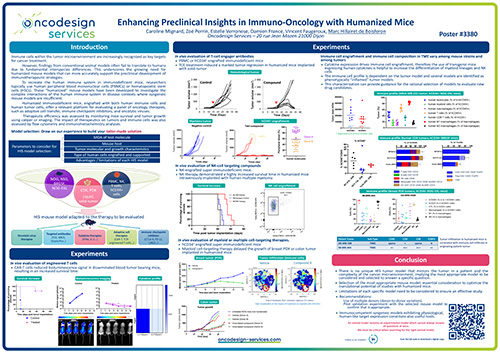
Immune cells within the tumor microenvironment are increasingly recognized as critical targets for cancer therapy. However, findings from conventional animal models often fail to translate effectively to humans due to fundamental interspecies differences. This limitation has driven the development of humanized mouse models capable of more accurately recapitulating human immune biology and supporting the preclinical evaluation of emerging immunotherapeutic strategies.
To recreate a functional human immune system in immunodeficient mice, researchers commonly engraft either human peripheral blood mononuclear cells (PBMCs) or hematopoietic stem cells (HSCs). These humanized mouse models enable the study of human immune cell development, activation, and tumor–immune interactions in vivo, addressing key gaps that traditional syngeneic models cannot. When coupled with the implantation of human tumor cell lines or patient-derived xenografts, humanized mice provide a uniquely relevant platform for assessing a broad spectrum of oncological therapeutic strategies, including adoptive immune cell therapies, immune checkpoint inhibitors, and oncolytic viruses.
In this work, we present tumor growth dynamics and immune profiling outcomes across both subcutaneous and disseminated intravenous humanized tumor models. Randomization strategies incorporating tumor burden and immune cell engraftment are outlined to enhance experimental robustness. Key readouts capturing immune modulation and antitumor efficacy are detailed.
Illustrative datasets and case studies demonstrate the versatility and translational value of these platforms for preclinical assessment of immune-oncology drug candidates. Overall, the findings highlight humanized mice as a powerful bridge between discovery research and clinical development.