



Tumors are not uniform targets
Solid tumors are not static masses. They are dynamic, heterogeneous systems shaped by evolving cell populations, disrupted signaling pathways, and a microenvironment that actively suppresses immune response.
This complexity creates familiar challenges in oncology drug development. Therapies must penetrate poorly vascularized tissue, remain active in immunosuppressive conditions, and maintain efficacy across diverse tumor cell populations. Even when early responses are observed, treatment resistance and relapse remain common among patients.
Many established modalities struggle with these constraints. Delivery can be inconsistent, activity may be localized, and biological responses do not always translate into durable clinical outcomes. As these challenges persist, interest in alternative therapeutic approaches has grown, including microorganisms (such as bacteria and (oncolytic) viruses), which are emerging as a modality inherently aligned with the biology of tumors.
Engineering a biological fit for the tumor microenvironment
Tumors create conditions that are permissive to microbial activity through alterations in oncogenic pathways that reduce intracellular defences against infection. At the same time, the tumor microenvironment often suppresses immune surveillance, allowing external agents like viruses and bacteria to persist where they would normally be cleared. Combined with enhanced permeability and retention effects, this creates an environment where microorganisms can accumulate, survive, and in some cases proliferate.
The concept of leveraging microorganisms in cancer treatment goes beyond basic delivery. Microorganisms do not behave as passive agents distributed through the bloodstream, but actively interact with a tumor, adapt to local conditions and, in certain cases, expand within it.
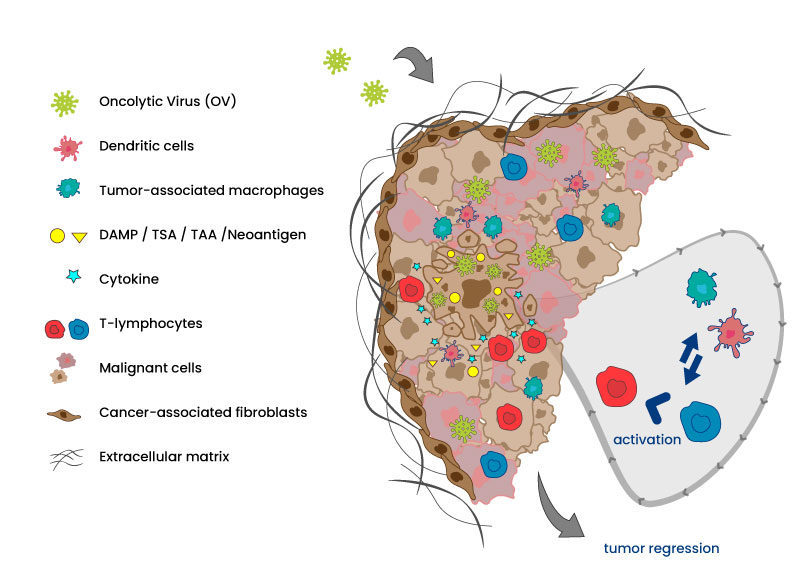
Above: Microorganisms such as oncolytic viruses (OVs) specifically enter and lyse cancer cells. Lysis delivers chemoattractant molecules and tumor antigens that activate dendritic cells and stimulate chemokines secretion. Innate and adaptative immune systems are awakened and recruited to also participate actively in tumor regression and eventually metastasis elimination.
This distinction between ‘active’ and ‘passive’ is important, as it shifts the paradigm from targeting through exposure to targeting through biological engagement. However, while natural tumor selectivity provides a starting point, the real potential of microorganisms in oncology lies in their ability to be engineered.
Viruses and bacteria can be modified to reduce virulence and improve safety profiles, while enhancing specificity for tumor tissue. More importantly, they can be programmed to deliver therapeutic functions directly within the tumor microenvironment.
These functions could include:
- Expression of chemokines that recruit immune cells
- Delivery of immunostimulatory proteins
- Localized production of antibodies or other therapeutic payloads
In this sense, microorganisms are not simply acting on tumors but operating within them, as adaptable, programmable systems. This level of functional integration is difficult to achieve with more conventional modalities.
A different model of tumor targeting
Traditional oncology therapies are often evaluated through the lens of pharmacokinetics: how a compound distributes, how long it persists, and at what concentration. Microorganisms require a different model.
Their activity is inherently dynamic. Following administration, they may migrate, localize, and expand over time. Their distribution is not defined by diffusion alone, but by biological interaction with the tumor and surrounding tissue.
This creates a targeting dimension that evolves over time:
- Initial delivery is only the first step
- Subsequent colonization and persistence determine activity
- Local interactions shape therapeutic outcome
For complex solid tumors, and particularly for environments that are difficult to access or poorly responsive to standard approaches, this model offers a distinct advantage.
Evaluating targeting and efficacy requires adaptation
Despite their potential, microorganism-based therapies introduce a critical challenge: they are often evaluated using frameworks developed for entirely different modalities.
Standard endpoints in oncology, such as tumor volume reduction, capture only part of the picture. They do not explain:
- Whether the microorganism reached the tumor
- How it distributed across tissues
- How long it persisted
- What immune responses it triggered
Without this information, interpretation becomes uncertain. For example, apparent efficacy may mask poor targeting, and a lack of response may reflect insufficient colonization rather than lack of therapeutic potential.
A more complete evaluation requires integrating multiple layers of analysis:
- Biodistribution, using imaging and molecular quantification
- Persistence and localization within tumor and organs
- Interaction with the tumor microenvironment
- Immune activation and downstream effects
Only by combining these readouts can the true activity of a microbial therapy be understood. When conducting microorganism studies, we apply a comprehensive panel of processes and analytical methods to help overcome the data gaps that can impact evaluation and translatability:

From behavior to impact
Microorganisms bring a fundamentally different approach to oncology. They are shaped by, and in turn reshape, the tumor microenvironment. They can be engineered to deliver function as well as exposure, and they operate through biological engagement rather than passive distribution.
However, while understanding how microorganisms they behave within tumors is essential, it is only the first step. The more impactful question is what that behavior enables—particularly in diseases where current therapies remain limited.
In the next part of this series, we will explore how microorganisms are being positioned to expand therapeutic reach in oncology, with a particular focus on metastatic disease and immune activation.
Subscribe to our LinkedIn newsletter to be notified when Part 2 is available.