




Supporting translational oncolytic virus research
Oncodesign Services supports oncolytic virus research through in vitro studies and in vivo pharmacology, combining more than 30 years of oncology expertise with advanced immuno-oncology capabilities. Using translational models and clinically relevant endpoints, we help biotechnology and pharmaceutical companies generate robust data to better understand mechanism of action and support progression toward the clinic.
Evaluating immune mechanisms
The therapeutic activity of oncolytic viruses extends beyond direct tumor cell killing. Durable responses depend on complex interactions between tumor biology, antigen expression, and immune activation. Our teams combine expertise in tumor biology, immunology, and translational pharmacology to evaluate these mechanisms and reduce risk during preclinical development.
Oncolytic virus research requires more than measuring tumor regression
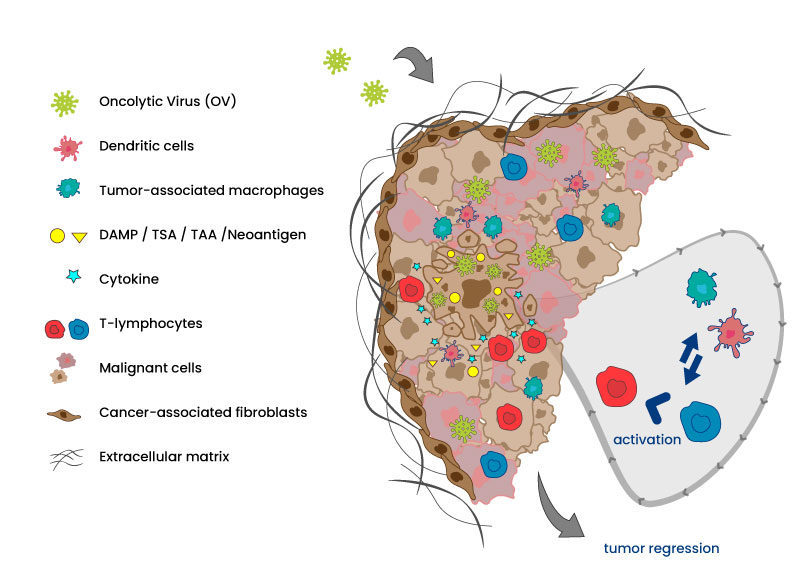
Although oncolytic viruses are designed to selectively infect and lyse tumor cells, their therapeutic activity is more extensive than cytotoxicity. Viral replication within tumors leads to the release of tumor antigens and inflammatory signals that recruit and activate components of the innate and adaptive immune systems. These mechanisms may contribute to local tumor control and, in some cases, systemic anti-tumor responses.
As a result, evaluating oncolytic virus candidates requires a broader understanding of immune biology. Tumor growth inhibition alone rarely provides a complete picture. Characterizing antigen expression, immune cell recruitment, and the dynamics of anti-tumor immunity can provide critical insights into mechanism of action and translational potential.
Preclinical capabilities for oncolytic virus research
Oncodesign Services provides flexible support for oncolytic virus research programs, including:
In vitro characterization
- Cytotoxicity and mechanism-of-action studies
- Cell viability and proliferation assays
- Immune-related biomarker analysis
- Combination studies with immunotherapies
In vivo oncology models
- Syngeneic tumor models
- Humanized mouse models
- Orthotopic and metastatic models
- Immunocompetent and immunocompromised strains
Translational endpoints
- Tumor growth and survival
- Flow cytometry and immune profiling
- Histology and immunohistochemistry
- Molecular analyses including qRT-PCR
- Multiplex cytokine and biomarker assessment
- Imaging-based readouts
Building confidence through translational study design
Viruses and tumors are both biologically diverse, and each program presents unique challenges. A deeper understanding of tumor immune evasion and host immune responses has enabled the development of increasingly sophisticated oncolytic approaches.
Whether evaluating standalone virotherapy approaches or combination strategies, our goal is to provide research that helps bridge the gap between promising biology and clinical development.
Frequently asked questions about oncolytic virus research
Why is understanding immune activation important in oncolytic virus research?
Tumor shrinkage does not fully explain the activity of an oncolytic virus. The release of tumor antigens and activation of immune pathways are recognized as important contributors to therapeutic response. Characterizing these processes through translational endpoints can provide valuable insight into mechanism of action and help guide future development.
Can oncolytic viruses be evaluated in combination with other therapies?
Yes. Oncolytic viruses are frequently investigated alongside immune checkpoint inhibitors, chemotherapy, radiotherapy, and other immunotherapies. Preclinical combination studies can help characterize synergistic effects and support the selection of clinically relevant treatment strategies.
What models are commonly used in oncolytic virus research?
The choice of model depends on the mechanism of action and stage of development. Syngeneic tumor models are frequently used to evaluate anti-tumor efficacy and immune responses, while humanized models can provide additional insight into interactions with human immune cells. Orthotopic and metastatic models may also be used to better reproduce tumor biology and disease progression.
Which endpoints are typically evaluated during preclinical oncolytic virus studies?
In addition to tumor growth inhibition and survival, researchers often assess immune cell populations, cytokine profiles, histopathology, molecular biomarkers, and imaging endpoints. Combining multiple readouts can help establish mechanism of action and support decision-making.