


In vivo models for inflammation and immune-mediated diseases.
Inflammatory diseases involve complex immune pathways, tissue remodeling, and systemic responses that vary widely across indications. Selecting the right inflammation models is integral to generating pharmacology data that accurately reflects disease biology.
Oncodesign Services supports biotechnology and pharmaceutical teams with in vivo inflammation pharmacology across a broad range of disease areas. Our platform facilitates off-the-shelf and custom models, supported by carefully designed studies and translational endpoints that help reveal how candidate therapies influence immune and inflammatory pathways.
Studies can be conducted as stand-alone pharmacology projects or integrated preclinical programs, enabling teams to generate robust data to guide the next stage of development.
Explore our inflammation models:
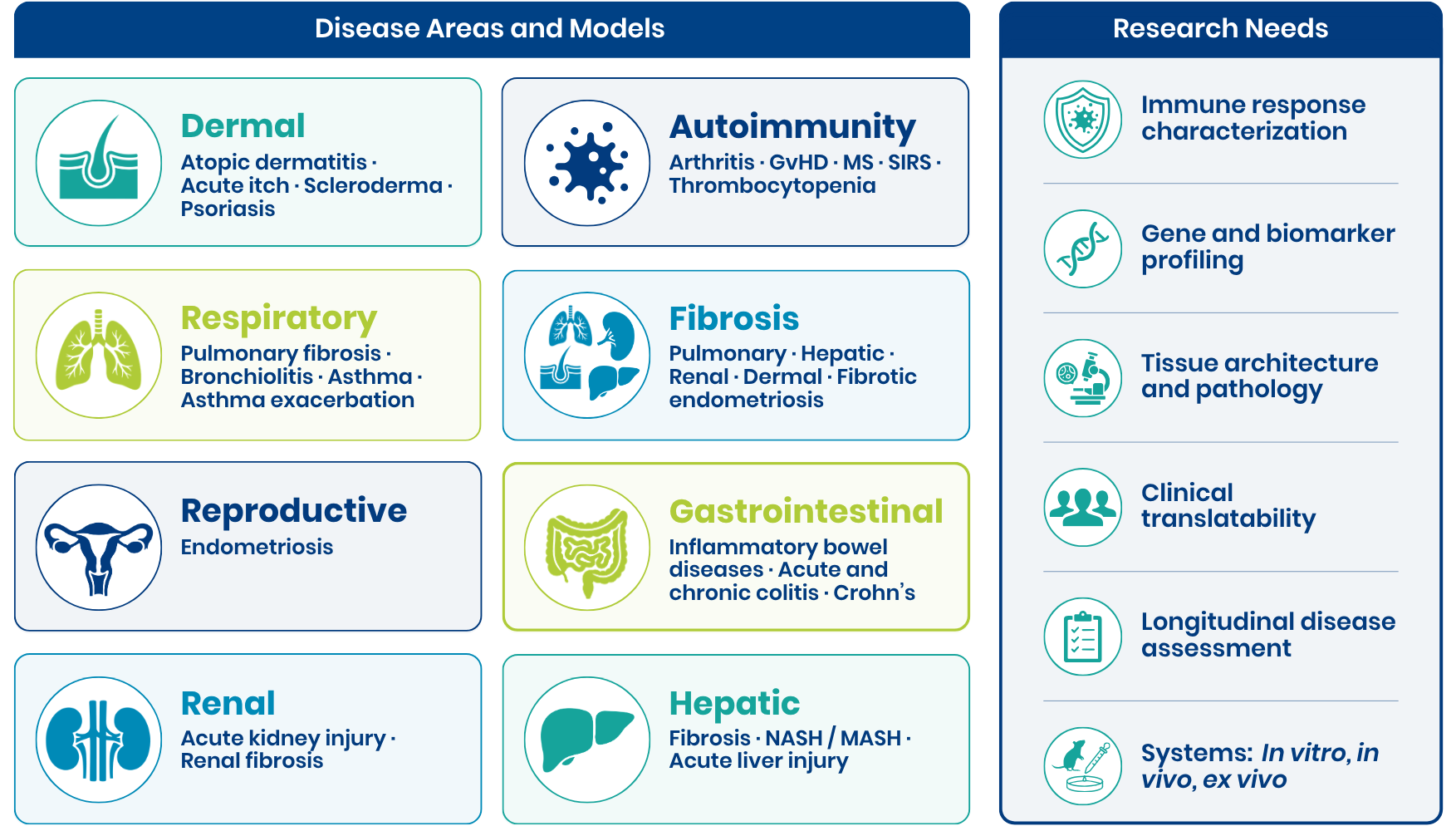
Our portfolio of in vivo inflammation models covers a wide spectrum of inflammatory and immune-mediated diseases. Explore the disease areas to learn more about available disease models and study capabilities.
Custom model development
Not every therapeutic program fits an established disease model. When standard models do not fully reflect the biology of a target, pathway, or treatment strategy, custom model development can help bridge that gap.
Oncodesign Services can support the development or adaptation of inflammation models tailored to specific research objectives. This may include modifying disease induction approaches, selecting alternative strains or species, or integrating specialized endpoints.
Custom models can also be combined with humanized systems when the presence of human immune cells is pertinent to the evaluation of therapeutic activity.
Inflammation pharmacology studies.
Inflammatory diseases rarely exist in isolation within a single tissue or pathway. Immune signaling, tissue injury, and remodeling processes often overlap across organs and indications, making model selection critical to successful pharmacology study design.
Oncodesign Services facilitates in vivo inflammation pharmacology studies designed to evaluate how therapeutic candidates influence inflammatory pathways and disease progression. We work closely with you to select models aligned with the biological mechanism of interest and impactful clinical questions.
This biology-driven approach helps ensure that pharmacology studies generate data capable of informing progression to clinic and real patient impact.
Humanized models for inflammation research
For many emerging therapies (particularly biologics, antibodies, and immune-modulating treatments) traditional murine models may not adequately represent human immune biology.
Humanized mouse models allow candidate therapies to be evaluated in the presence of human immune cells, enabling investigation of immune interactions, target engagement, and therapeutic activity within a human-relevant immune environment.
Oncodesign Services supports inflammation research using human immune system (HIS) models, including BRGSF-HIS mice, which are particularly valuable when studying:
- Human-specific immune targets
- Immunotherapies and biologics
- Complex immune pathway interactions
- Translational pharmacology questions involving immune modulation
Humanized models can be integrated with several inflammatory disease models to provide deeper insight into immune-driven disease mechanisms and therapeutic response.
Learn more about humanized model systems →
Typical inflammation pharmacology readouts
In many inflammatory diseases, traditional endpoints such as lesion severity or histological scoring alone are critical but do not fully capture disease burden or therapeutic impact.
To better connect preclinical findings with clinical outcomes, functional and translational readouts are increasingly incorporated into inflammation pharmacology studies.
Depending on the model and disease area, available endpoints could include:
- Histopathology and disease scoring
- Immune cell profiling and flow cytometry
- Cytokine and biomarker analysis
- Gene expression analysis
- Fibrosis quantification
- Imaging-based disease monitoring
- Survival and longitudinal disease monitoring
- Organ function
- Biochemistry and haematology
Combining disease-relevant models with carefully selected endpoints allows studies to generate a more comprehensive understanding of therapeutic activity and mechanism.
Looking for the right inflammation pharmacology program?
Our scientists work with biotechnology and pharmaceutical teams to design inflammation pharmacology studies that generate scientifically strong, clinically relevant data.
Frequently asked questions about our in vivo inflammation models
What readouts are commonly used in inflammation studies?
In inflammation studies, a range of biomarker readouts are commonly used to provide a comprehensive view of the biological processes involved:
- Histology is widely used to evaluate tissue-level changes such as inflammation, fibrosis, and infiltration by specific immune cell types.
- qRT-PCR performed on inflamed organs or tissues helps assess gene expression patterns related to the inflammatory response, including markers of Th1/Th17 or Th2 pathways and profibrotic genes.
- Flow cytometry (FACS) enables precise quantification of immune cell subpopulations in tissues, peripheral blood mononuclear cells (PBMCs), spleen, and lymph nodes.
- Functional readouts, when applicable, provide insight into physiological consequences of inflammation, such as itch responses or respiratory function measured by plethysmography.
- Serum cytokine analysis is used to monitor circulating levels of inflammatory mediators, offering information on the kinetics and type of immune response (e.g., Th1/Th17, Th2, or fibrotic).
- Imaging techniques such as CT or MRI allow for the assessment of macroscopic tissue damage and structural changes associated with chronic or severe inflammation.
Can in vivo inflammation models be customized for specific therapeutic targets?
Yes, inflammation models can be customized to align with specific therapeutic targets.
This can be done in two main ways. First, protocols may be adjusted to reflect differences from published studies, for example, when adapting a model described in the literature to better suit specific experimental conditions or objectives. Second, more general modifications can be applied, such as adjusting the dose of inflammatory inducers to modulate response intensity, or adapting treatment routes and administration schedules to match the intended therapeutic approach.
These options provide the flexibility needed to generate models that are both relevant to the target of interest and tailored to the study design.
What endpoints are most predictive in inflammation pharmacology studies?
There is no single “best” endpoint in inflammation pharmacology studies; rather, the most predictive approach relies on the complementarity of multiple readouts.
Clinical or functional endpoints provide direct insight into disease burden and its relief following treatment. Histological analysis reflects the extent of tissue damage and structural changes, offering a detailed view of disease severity at the organ level. Meanwhile, cytokine measurements and other molecular biomarkers capture specific components of the inflammatory response, helping to elucidate the underlying biological pathways and mechanisms of action.
By combining these different types of endpoints, researchers obtain a more complete and predictive assessment of therapeutic efficacy.
What strategies can be used when a therapeutic target is not cross-reactive between mouse and human?
When a target is not cross-reactive, two main strategies can be considered:
- Genetically humanized models are often the preferred approach. These involve knocking out the murine gene and knocking in the human counterpart, followed by validation of its functionality. This strategy preserves an intact immune system (i.e., no immunosuppression) and allows studies to be conducted on a genetic background consistent with standard disease models.
- Models reconstituted with a human immune system represent an alternative. These models are generated using highly immunosuppressed animals engrafted with human CD34+ hematopoietic cells. While useful, they rely on a severely compromised immune system, which can limit physiological relevance compared to fully immunocompetent models.
The choice between these approaches depends on the target, study objectives, and required level of translational relevance.