

Success in early radiopharmaceutical development requires more than a promising in vitro molecule.
View this webinar to learn:
- Understand the challenges of translating promising in vitro candidates into radiopharmaceuticals.
- Identify how pre-targeting and other optimization strategies can support successful radiopharmaceutical development.
- Assess the impact of radionuclide and chelator selection on candidate design.
- Explain how biodistribution, circulation time, and clearance influence therapeutic and diagnostic performance.
Overcoming preclinical challenges around radionuclide selection, biodistribution, circulation, and clearance.
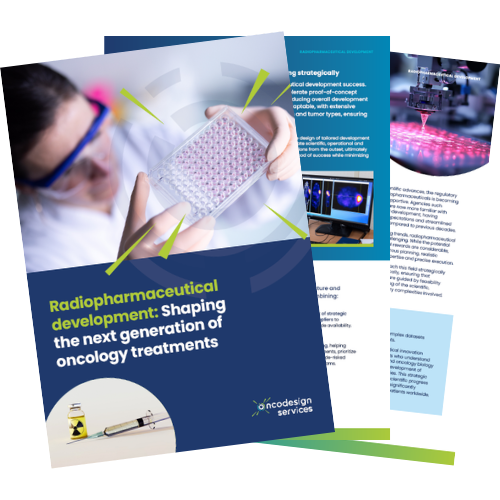
The rapid growth of radiopharmaceuticals is creating new opportunities for oncology drug developers, but success requires more than attaching a radionuclide to a promising compound. This field of therapeutic development requires a different approach than conventional drug development.
Radiopharmaceutical candidates that demonstrate excellent in vitro performance may fail to achieve effective biodistribution, circulation time or tumor targeting in vivo, while inappropriate radionuclide or chelator selection can compromise development before a program reaches the clinic.
This webinar details the scientific considerations involved in de-risking and optimizing promising in vitro candidates for radiopharmaceutical development. Through practical examples, you will examine how factors including radionuclide and chelator selection, linkers and pre-targeting strategies influence biodistribution, circulation and clearance to boost candidate performance.
You will also explore how key design decisions shape both diagnostic imaging and therapeutic applications, and which specific approaches are required for radiopharmaceutical development. View this webinar to gain a clearer understanding of the preclinical challenges encountered during radiopharmaceutical development and the strategies available to address them.
Whether you are evaluating your first radiopharmaceutical candidate or optimizing an existing program, view this session to gain practical insights that will support more informed design decisions and improve the likelihood of successful translation.