





Choosing preclinical models across KRAS mutations, indications, and therapeutic strategies.
KRAS has long been considered one of oncology’s most compelling yet difficult to engage therapeutic targets. Its central role in tumor biology is well established; however, efforts to bind and inhibit KRAS mutations in patients, either directly or indirectly, have repeatedly proved unsuccessful. This challenge largely stems from KRAS acting as a molecular switch, where oncogenic mutations lock the protein in its active GTP-bound “ON” state, limiting access to the inactive “OFF” conformation.
The approval of KRAS G12C inhibitors (Sotorasib, 2021) demonstrated that direct targeting of KRAS is possible, and a rapidly expanding pipeline is now exploring additional mutations, therapeutic approaches and combination strategies. Development activity has accelerated sharply, with a growing number of candidates progressing through preclinical development and entering clinical trials, and a new RAS(ON)-inhibiting drug for pancreatic cancer recently receiving FDA approval (Daraxonrasib, sold as Rasonque, August 2026).
As the field advances, however, the preclinical questions around KRAS-targeted research are becoming more nuanced. It’s no longer enough to ask whether a model demonstrates a KRAS mutation. Researchers must consider the specific mutation (such as G12C, G12D, G12V or G12R), tumor indication, molecular context and characteristics of the model when designing studies to evaluate emerging therapies.
KRAS mutations are common in cancer.
KRAS mutations are the most common genetic mutations associated with cancer1. Research suggests that RAS mutations are present in 30% of all cancers, with KRAS accounting for 85% of those occurrences2. It is found across multiple solid tumors and is particularly prevalent in pancreatic, colorectal and non-small cell lung cancers3.
The development of KRAS G12C inhibitors represented an important step forward, particularly in non-small cell lung cancer. Attention has since expanded towards other prevalent mutations and broader approaches to disrupting RAS signaling. Emerging results in advanced pancreatic cancer research are demonstrating the potential of new RAS-targeted approaches to improve patient outcomes in a disease where effective treatment options remain limited.
At the same time, questions around treatment response, acquired resistance and combination strategies are becoming increasingly important. This creates a fundamental challenge for preclinical research: How can researchers select preclinical models that capture the influence of KRAS mutation status and tumor-specific biology on therapeutic response?
Model selection requires nuance beyond the basic presence of a KRAS mutation.
Molecular characterization is an important consideration when selecting a preclinical oncology model. However, mutation status alone does not define the disease. The experimental question therefore needs to extend beyond the presence or absence of a particular mutation. Researchers may need to consider the indication, additional molecular characteristics, tumor heterogeneity and disease behavior alongside the specific mechanism of action of the therapeutic candidate.
For example, two pancreatic PDX models carrying the same KRAS G12D mutation may differ in TP53 status and other molecular characteristics. Evaluating activity across these distinct backgrounds can help researchers assess whether a therapeutic response is consistent across models sharing the intended target mutation.
These considerations become particularly important as KRAS-targeted development moves towards increasingly precise therapeutic strategies. Selecting a model should therefore begin with the biology and objectives of the study rather than simply searching for a tumor carrying the required mutation.
The role of CDX vs PDX models in KRAS research.
Both cell line-derived xenograft and patient-derived xenograft models can contribute to the preclinical evaluation of KRAS-targeted therapies.
CDX models provide established and well-characterized experimental systems that can support controlled evaluation of therapeutic activity. Publicly available molecular data can also enable researchers to identify cell lines carrying specific KRAS mutations and other relevant genomic characteristics.
For example, widely used pancreatic cancer cell lines MIA PaCa-2 and PANC-1 carry KRAS G12C and G12D mutations, respectively. Both also harbor TP53 mutations and CDKN2A deletions, illustrating how established cell lines can be selected according to KRAS status and additional molecular characteristics.
This can make CDX models particularly useful when researchers require a defined molecular background or are evaluating early questions around pharmacological activity.
PDX models facilitate a different research requirement. By directly establishing tumors from patient material, PDX models can retain important characteristics of the original tumor, including aspects of its molecular complexity and heterogeneity. For researchers developing therapies against specific KRAS mutations, access to molecularly characterized PDX models can therefore provide an opportunity to evaluate activity in a more heterogeneous tumor context and support assessment of translational relevance. Single mouse preclinical trial (SMPT) studies extend this approach by evaluating treatment response across a panel of PDX models derived from different patients. Retrospective analysis of molecular profiles alongside treatment responses can then help identify genetic characteristics associated with sensitivity or resistance4.
Neither approach is universally appropriate and the true value lies in selecting the model that best reflects the biological question at the appropriate stage of development and the evidence required from the study to advance the development of a candidate.
Matching KRAS mutations with tumor context.
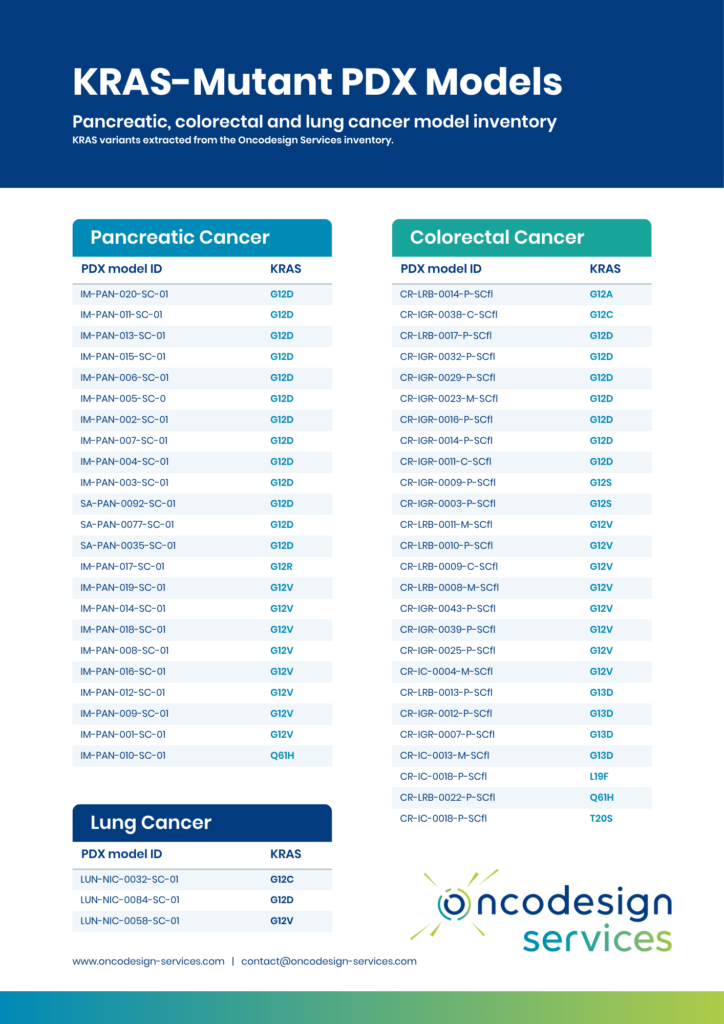
The increasing diversity of KRAS-targeted approaches creates a corresponding need for greater choice in preclinical models. Oncodesign Services provides CDX and PDX models across pancreatic, colorectal and lung cancers carrying a range of KRAS mutations. We can support in vitro, in vivo and ex vivo studies, including single mouse preclinical trials and retrospective genomic and transcriptomic analyses to investigate molecular correlates of treatment response and support patient stratification strategies.
The PDX collection includes characterized models with prevalent KRAS mutations such as G12D, G12V and G12C, alongside less-common KRAS variants. This provides researchers with opportunities to select models according to both molecular characteristics and tumor indication.
For example, pancreatic cancer models are available carrying G12D and G12V mutations, while the colorectal collection covers a broader range of variants including G12C, G12D, G12V, G13D and Q61H. KRAS-mutant lung cancer models include G12C, G12D and G12V.
No individual model can reproduce every aspect of human disease. However, careful selection based on mutation status, tumor indication, molecular characteristics and study objectives can support the generation of evidence that is both demonstrable in an early setting and translational.
As the KRAS pipeline continues to expand, choosing the right preclinical model will become an increasingly important part of translating promising therapeutic strategies towards the clinic.
Scientific Contributor
Ismahéne Benzaid, PhD.

Dr. Ismahéne Benzaid is a Study Director at Oncodesign Services, where she designs and manages preclinical research programs for industry partners. She holds a Ph.D. in cancer immunology from Université Claude Bernard Lyon 1 and conducted postdoctoral research at INSERM and Moffitt Cancer Center. Her expertise includes γδ T-cell and CAR T-cell immunotherapies, with research focused on improving antitumor activity, cell trafficking, and tumor homing in solid tumors. Her work includes peer-reviewed publications in Clinical Cancer Research and Cancer Letters.



-
Bibliography
1. Hunter, John C., et al. “Biochemical and Structural Analysis of Common Cancer-Associated KRAS Mutations.” Molecular Cancer Research: MCR, vol. 13, no. 9, Sept. 2015, pp. 1325–35. PubMed, https://doi.org/10.1158/1541-7786.MCR-15-0203.
2. Wu, Liyuan, et al. “Pan-Cancer Analysis to Character the Clinicopathological and Genomic Features of KRAS-Mutated Patients in China.” Journal of Cancer Research and Clinical Oncology, vol. 151, no. 2, Feb. 2025, p. 94. PubMed Central, https://doi.org/10.1007/s00432-025-06118-9.
3. Huang, Lamei, et al. “KRAS Mutation: From Undruggable to Druggable in Cancer.” Signal Transduction and Targeted Therapy, vol. 6, no. 1, Nov. 2021, p. 386. www.nature.com, https://doi.org/10.1038/s41392-021-00780-4.
4. Julien, Sylvia, et al. “Characterization of a Large Panel of Patient-Derived Tumor Xenografts Representing the Clinical Heterogeneity of Human Colorectal Cancer.” Clinical Cancer Research: An Official Journal of the American Association for Cancer Research, vol. 18, no. 19, Oct. 2012, pp. 5314–28. PubMed, https://doi.org/10.1158/1078-0432.CCR-12-0372.